Last Breath (2025)
Last Breath (2025) Review: A Suffocating, True-Story Survival Thriller That Hits Deep
 |
| Image Source: IMP Awards |
Imagine the lights in the theater dimming until the room is as black as a windowless basement. Before you see a single frame of film, you hear it. A mechanical, rhythmic sound that is both comforting and terrifying: Hiss. Pause. Hiss. It’s the sound of a regulator. It’s the sound of life being delivered through a hose in a place where life shouldn't exist. By the time the title card for Last Breath (2025) finally flickered onto the screen, I realized I was already breathing in sync with the characters. I wasn’t just watching a movie; I was being submerged.
I went into this screening with a bit of skepticism. We’ve seen the "survival at sea" trope a thousand times, right? Usually, it’s a shark, a rogue wave, or a sinking ship. But Last Breath is something far more intimate and, frankly, far more haunting. It’s based on an "extraordinary true story," a phrase that usually feels like marketing fluff, but here, it acts as a heavy weight sitting on your chest for the entire runtime. When you know that real men—real, breathing human beings—actually faced this abyssal silence, the movie stops being "entertainment" and starts being a test of your own endurance.
The Face of the Abyss
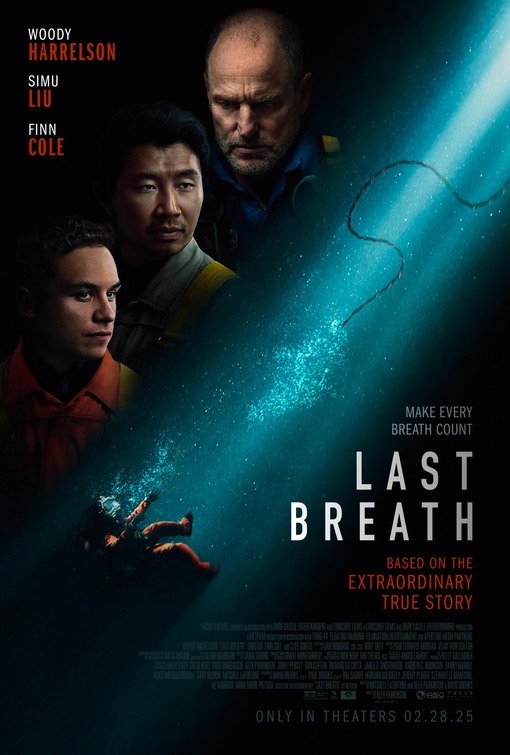
The first thing that struck me wasn't the water, but the faces. Look at the poster for a second. You have Woody Harrelson, Simu Liu, and Finn Cole looking out from the darkness. In a typical Hollywood blockbuster, these guys would look heroic. They’d have that "I’m about to save the day" glint in their eyes. But in Last Breath, they look... exhausted. Harrelson’s face, in particular, is a roadmap of worry. He’s at the top of the poster, looking down, his brow furrowed in a way that makes you feel the literal atmospheric pressure of the deep sea.
The movie spends a good chunk of time establishing the world of commercial saturation diving. If you’re like me and didn't know what that was, prepare to be fascinated and horrified. These guys live in a pressurized tank for weeks at a time, their bodies so saturated with helium and oxygen that they can't just "go to the surface" if something goes wrong. If they do, their blood would literally boil. They are, for all intents and purposes, astronauts on the bottom of the ocean.
Woody Harrelson plays the veteran, the guy who has seen it all and carries the quiet authority of someone who knows exactly how many ways the ocean can kill you. Harrelson has reached that point in his career where he doesn't need to do much to command a scene. A flick of his eyes or a tightening of his jaw tells you everything you need to know about the stakes. He isn't playing a hero; he’s playing a foreman. And that realism is what makes the inevitable disaster so much harder to swallow.
When the Tether Snaps
The plot kicks into high gear when a "saturation" dive in the North Sea goes catastrophically wrong. A storm hits the support vessel, the positioning system fails, and the "umbilical"—the literal lifeline that provides air, light, heat, and communication to the diver on the bottom—is severed.
This is where the film's visual language really shines. The poster captures this perfectly with that diagonal slash of bioluminescent, bubbling blue light cutting through the pitch-black void. Below that light, you see a lone diver, suspended in nothingness. That image haunted me throughout the middle act. Director Alex Parkinson (who also directed the incredible documentary of the same name) uses the darkness as a character. You aren't just seeing what the diver sees; you are feeling the limit of his vision.
Simu Liu brings a frantic, modern energy to the crew that balances Harrelson’s stoicism. We’re used to seeing Liu as a superhero or a charming lead, but here, he is stripped of all that armor. He is vulnerable, reactive, and intensely human. Finn Cole, the youngest of the trio, acts as the audience surrogate. His terror is our terror. When his character realizes that the "Make Every Breath Count" tagline isn't just a motivational quote but a literal countdown to his death, you can see the light go out in his eyes.
The Sound of Silence
I need to talk about the sound design because it is, without exaggeration, some of the best I’ve heard in years. In most movies, silence is just the absence of noise. In Last Breath, silence is heavy. It’s thick. It’s the sound of the ocean pressing against the hull of a diving bell. When the communications cut out and the only thing left is the sound of a lone man’s breathing inside a metal helmet, the tension becomes almost unbearable.
There were moments where I found myself looking around the theater, and I wasn't the only one shifting uncomfortably. People were adjusting their collars, taking deep breaths, trying to remind themselves that they weren't actually 300 meters below the surface. The film uses the PG-13 rating effectively. It doesn't need gore to scare you; it just needs the relentless ticking of a clock and the slow realization that there is no "Plan B."
Where the Film Drifts
Now, I promised to be honest, so let’s talk about the parts that didn't quite work for me. While the "true story" aspect is the film’s greatest strength, it’s also a bit of a narrative straitjacket. Because the filmmakers are staying relatively true to what actually happened, the pacing in the second act can feel a bit repetitive. There are only so many ways you can show a man waiting in the dark before the audience starts to get as restless as the characters.
There’s also a subplot involving the crew on the ship above that feels a bit more "Hollywood" than the rest of the film. The dialogue in these scenes can occasionally veer into cliché territory—the panicked technician, the captain making the tough call, the "we can't give up on him!" speeches. After the visceral, quiet horror of the underwater scenes, these moments felt a little loud and performative. I found myself wanting to get back to the bottom of the ocean, even though the bottom of the ocean was the last place I’d actually want to be.
Technical Mastery and the "Blue" Void
Technically, the film is a marvel. The VFX, combined with what look like very difficult practical underwater shots, create a seamless environment. You never doubt for a second that these actors are in peril. The production companies involved—Focus Features, Dark Castle, and Longshot Films—clearly put their resources into making the ocean feel like an alien planet.
The use of light is especially interesting. In the poster, there’s that eerie, glowing blue light that seems to be coming from nowhere and everywhere at once. In the film, this light represents hope, but it’s a flickering, unreliable hope. The way the light catches the bubbles and the sediment in the water creates a dreamlike quality that contrasts sharply with the gritty, industrial reality of the diving gear.
A Personal Afterthought
I left the theater on February 28, 2025, and walked out into a cold, drizzly evening. Usually, when I leave a thriller, I’m buzzing with adrenaline. But after Last Breath, I just felt quiet. I felt a weirdly profound sense of gratitude for the simple act of being able to see the sky and breathe air that wasn't being pumped through a tube.
The movie sticks with you because it taps into a very specific, primal fear: the fear of being forgotten in the dark. It’s not just about the physical danger; it’s about the psychological toll of realizing how small we are compared to the natural world. The tagline "Make Every Breath Count" felt a bit cheesy when I first saw the poster. But after seeing what these men went through, it feels like a genuine plea.
Final Thoughts: To Dive or Not to Dive?
If you’re looking for a fast-paced action movie with explosions and one-liners, Last Breath is going to frustrate you. It’s a slow burn. It’s a movie that asks you to sit in discomfort and contemplate the mechanics of your own survival. It’s a tribute to the sheer, stubborn will of the human spirit to keep living, even when every law of physics says you should be dead.
Woody Harrelson, Simu Liu, and Finn Cole turn in performances that are stripped of ego, focusing instead on the collective effort of a crew under pressure. While the pacing hits a few snags in the middle and the "above-water" drama can be a bit thin, the core of the movie—the 40 minutes of absolute, isolated terror on the sea floor—is some of the most compelling cinema I’ve seen in a long time.
Just a word of advice: don't see this if you have a cold. The sound of your own congested breathing might just be enough to push you over the edge.


Comments
Post a Comment